
The stroke clock for emergency department teams
One shared clock the whole team can see, from door to needle, puncture, or transfer — so everyone knows where the protocol stands.
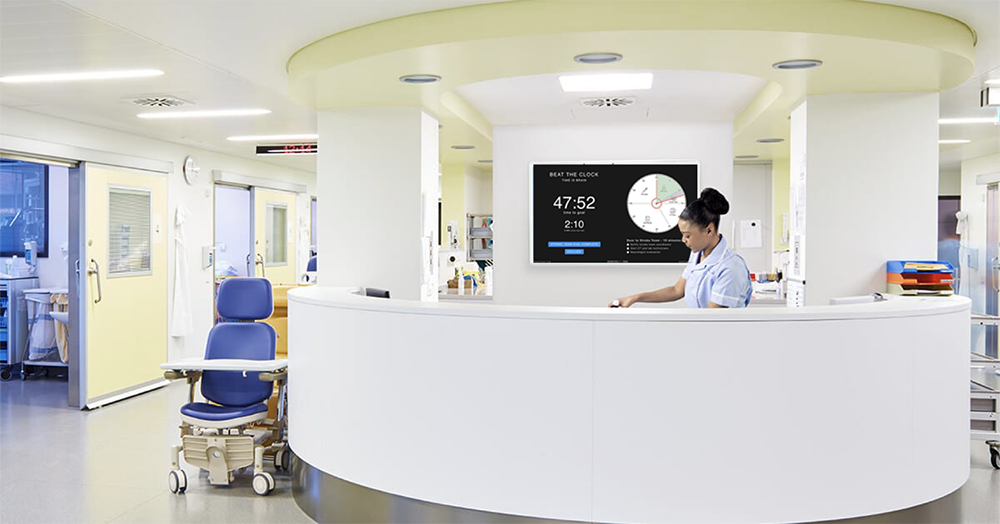
Time is brain
Primary Stroke Center, New Jersey community hospital — three years of use. See the study.
Follows your pathway
Some teams go door to needle. Some go straight to thrombectomy. Some stabilize and transfer to a comprehensive stroke center. The protocol phases, sequence, checklists and time targets are configured per facility, so the clock tracks the pathway your team actually follows — and the reports measure your target endpoint.
One clock live, numbers later
Real-time tracking
A central point of reference removes any confusion about where the protocol stands. The active code can be displayed on multiple devices at once and pushed to a large screen the whole team can read. Put a display in the pharmacy and the tPA is mixed and ready on time.
Easy to read display
Large digital clocks and an animated, color-coded stopwatch stay legible from across the room. Phase checklists sit below the clock to keep the team on the next task.
Analyze and improve
Each protocol ends with its phase timings on screen and can be printed for the chart. The reports portal shows those timings across activations, so coordinators can see where delays cluster and track progress toward their goals.
Runs on everything
Trauma Timer is a platform-independent web app — Windows, Mac, iOS, Android or Chrome. The usual deployment is inexpensive tablets where the team works and a large display the floor can read, kept entirely separate from hospital systems. It runs equally well on existing workstations. A facility subscription covers multiple stations, big-screen central display, secure storage of protocol timings, and the online reports used to measure and improve performance.
No patient data. No IT project.
- The application has no field for a patient name, medical record number, or any other identifier — it cannot capture patient information.
- Sessions are identified by sequential number only. Stored results are protocol timings, nothing more.
- No interface to the EHR, no imaging feed, no data exchange to build or maintain.
- Deployable on isolated devices, so nothing needs to touch the hospital network.
The evidence
Beat the Clock: Using a Visual Tool for Process Improvement in Ischemic Stroke Care Door-to-Needle Times
Trauma Timer was evaluated at a New Jersey community hospital's Primary Stroke Center, over three years of use compared with the prior period at the same institution. Average door-to-needle time fell from 81.5 minutes to 38.2, and the tPA administration rate rose from 15% to 21%. The hospital held door-to-needle under 45 minutes in 75% of cases and under 60 minutes in 90%.
Effects of a Feedback-Demanding Stroke Clock on Acute Stroke Management
A randomized trial at Saarland University Medical Center in Homburg, Germany, led by Dr. Klaus Fassbender, found that a stroke clock demanding active feedback significantly improved acute stroke-management metrics — and described it as a low-cost way to streamline time-sensitive stroke treatment.
Get With The Guidelines–Stroke Is Associated With Sustained Improvement in Care for Patients Hospitalized With Acute Stroke or Transient Ischemic Attack
Across 322,847 patients at 790 US hospitals, Dr. Lee H. Schwamm and colleagues found participation associated with improved adherence to every stroke performance measure, with gains seen regardless of hospital size, geography, or teaching status.
See it run
Arrange an online demonstration and a configuration and pricing discussion for your facility.